•5 min read•Verified by Colorado Licensed Plumbers
Do I Need a Water Heater Expansion Tank in Colorado? Code & Physics
When replacing a water heater or upgrading plumbing, homeowners frequently ask whether installing a thermal expansion tank is truly necessary or just an optional add-on. Along the Colorado Front Range, modern closed-loop plumbing systems make thermal expansion tanks an absolute engineering necessity and a strict code mandate. Here is how they protect your home.
Experiencing an active water heater emergency in Littleton? Shut off your cold water supply and call our dispatch desk.
To understand why modern homes require an expansion tank, you must understand the basic behavior of water under temperature changes. Water is an incompressible liquid; when you heat it, its molecular structure vibrates more rapidly, demanding more physical space.
When a standard 50-gallon residential water heater takes in cold winter water at 40°F and heats it to 125°F, the total volume of water expands by approximately two percent. That two percent thermal expansion adds roughly one full gallon of physical volume inside the plumbing system.
Because water cannot be compressed, that additional gallon of liquid must go somewhere. If there is no air cushion or relief outlet available, the expanding water exerts extreme hydrostatic force outward against pipe walls, valve gaskets, flexible supply lines, and water heater steel tank seams. Without expansion control, domestic water pressure can easily spike from a normal 60 PSI to over 150 PSI every time your water heater fires.
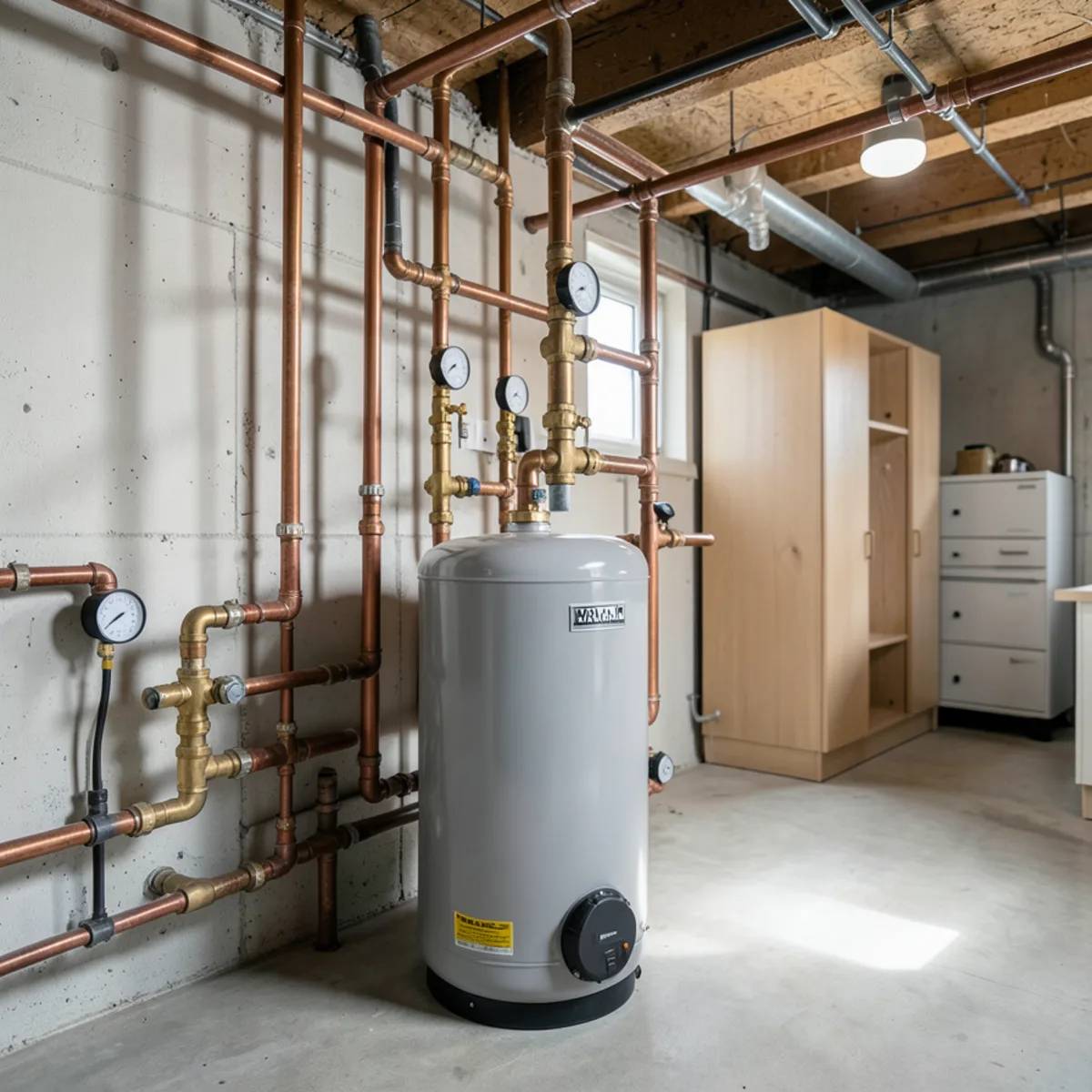
The internal butyl rubber membrane separates pre-pressurized air from domestic water, cushioning thermal pressure spikes.
Open Systems vs. Closed-Loop Plumbing Networks
Decades ago, most municipal plumbing systems in Colorado operated as open networks. In an open system, when water expanded inside a home water heater, the extra volume simply pushed backward through the water meter and dissipated into the massive municipal water main beneath the street.
Over the past twenty-five years, water authorities and public health agencies—including Denver Water and municipal water districts throughout Arapahoe, Douglas, and Jefferson counties—systematically eliminated open networks to protect public drinking water quality.
To prevent contaminated water (from lawn irrigation systems, boiler systems, or chemical back-siphonage) from flowing back into the public water supply, utilities mandated backflow prevention devices, dual-check valves, and pressure reducing valves (PRVs) at the domestic water meter. While these devices protect municipal water supplies, they create a one-way street: water can enter your home, but it can never push backward into the street. Consequently, your domestic plumbing becomes a sealed closed loop.
Need a Licensed Water Heater Specialist in Littleton?
Fast diagnostic triage, upfront quotes, and zero pressure. Call our local shop directly.
A thermal expansion tank is a compact, heavy-duty steel cylinder installed on the cold water supply pipe directly upstream of your water heater. Internally, the tank is divided into two distinct chambers separated by a flexible, food-grade butyl rubber diaphragm:
1. The Upper Chamber: Connects directly to your home domestic water piping and fills with water.
2. The Lower Chamber: Sealed at the factory and charged with compressed air through a standard automotive Schrader valve.
When your water heater fires and water begins to expand, the excess volume encounters the flexible rubber diaphragm. Because air is a gas and easily compresses (unlike liquid water), the diaphragm moves downward, compressing the air cushion and safely absorbing the extra water volume.
Once hot water faucets are opened and system pressure stabilizes, the compressed air pushes the diaphragm back upward, returning the water smoothly into circulation. This simple, elegant mechanism keeps household water pressure completely stable, preventing violent pressure spikes.
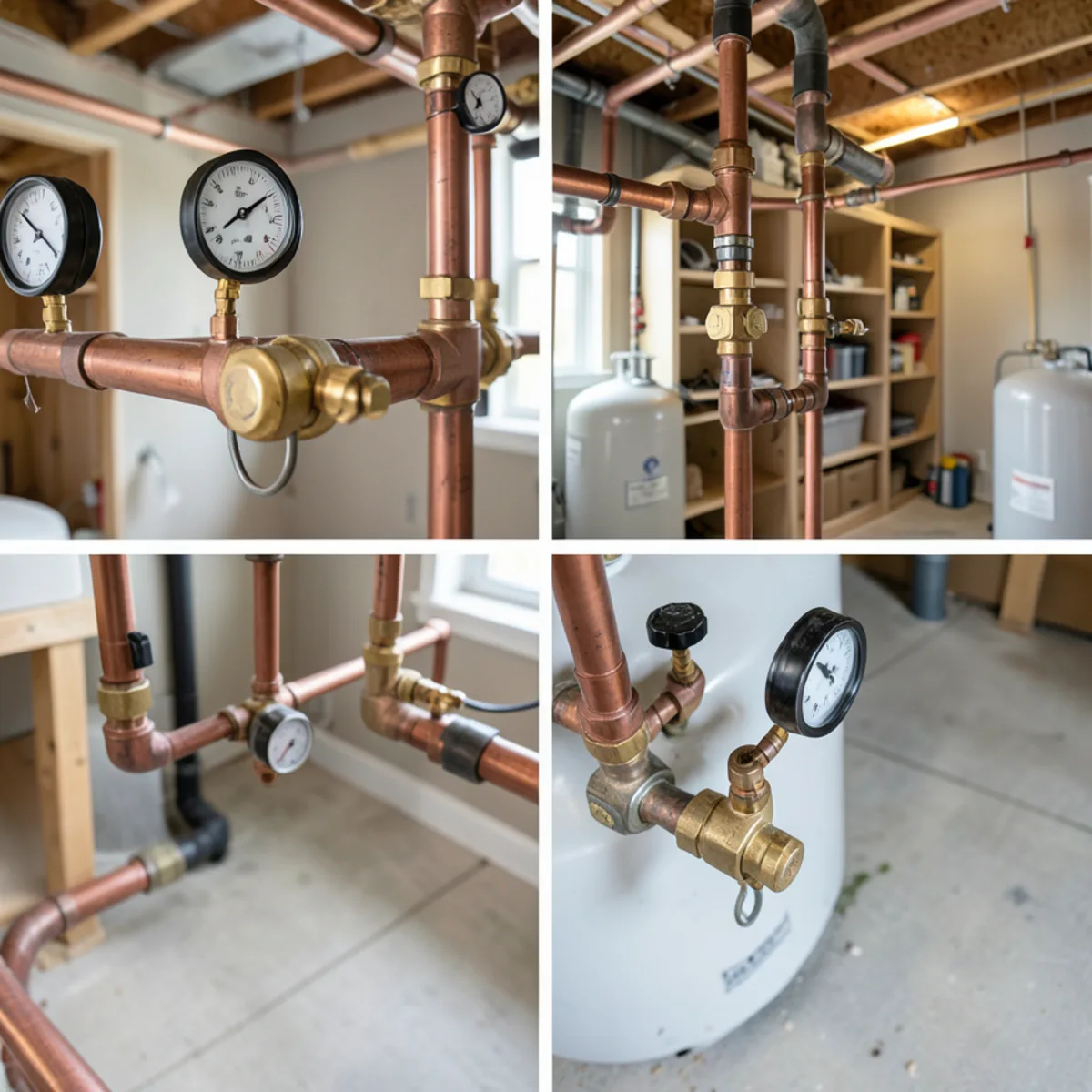
Pre-charging the expansion tank air chamber to match incoming household street pressure is required before line connection.
Symptoms of a Missing, Failed, or Waterlogged Expansion Tank
If your home has a closed-loop water system without an expansion tank, or if your existing expansion tank has failed internally, you will likely notice several distinct symptoms:
1. Weeping T&P Relief Valve: The temperature and pressure relief valve on your water heater weeps or discharges small puddles of water onto the floor during or immediately following heating cycles.
2. Toilet Fill Valve Hissing: High-pressure spikes push past internal rubber flappers and toilet ballcocks, causing toilets to intermittently run or hiss spontaneously without being flushed.
3. Sudden Faucet Blasts: When turning on a sink faucet, water bursts out with excessive force for the first two seconds before settling down to a normal stream.
4. Hydraulic Water Hammer: Pipes bang or shudder inside walls when washing machines, dishwashers, or faucets shut off rapidly.
To test an existing expansion tank, locate the small brass Schrader valve on the bottom or side of the tank. Depress the center valve stem briefly with a fingernail. If a brief puff of air escapes, the internal bladder is intact. However, if water squirts out of the air valve, the internal butyl diaphragm has ruptured, rendering the tank waterlogged and useless. A waterlogged tank must be replaced immediately.
Littleton Building Codes and International Plumbing Code Mandates
In the City of Littleton, Arapahoe County, and throughout Colorado municipalities enforcing the International Plumbing Code (IPC), thermal expansion control is not optional; it is legally required by building safety regulations.
IPC Section 607.3 states that wherever a backflow preventer, check valve, or pressure-reducing valve creates a closed system, an approved device for controlling thermal expansion must be installed. During any permitted water heater installation or replacement, municipal building inspectors will fail the inspection if an approved thermal expansion tank is absent.
Furthermore, major water heater manufacturers (including Bradford White, Rheem, and A.O. Smith) specify in their warranty documents that operating a water heater on a closed system without a functioning expansion tank voids the manufacturer warranty. If a tank fails prematurely due to cyclic pressure fatigue, warranty claims can be denied without proof of an installed expansion device.
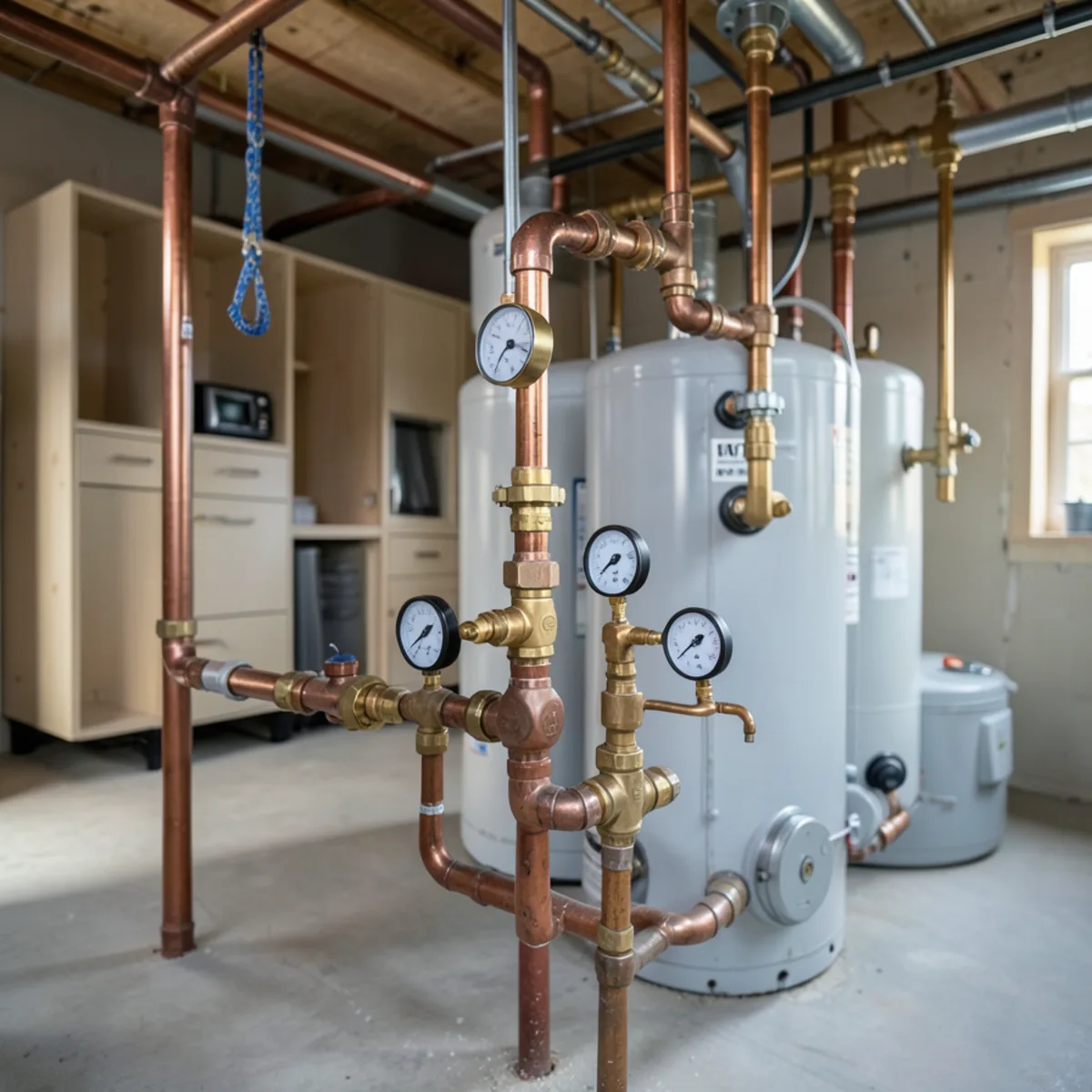
Rigid brass tee fittings and seismic strapping ensure expansion tanks remain securely mounted above cold water supply lines.
Proper Calibration: Pre-Charging to Match Street Pressure
Installing an expansion tank correctly involves more than simply screwing it onto a pipe. The internal air pressure must be precisely calibrated to match your home static water pressure before the tank is connected to live plumbing lines.
Expansion tanks come from the factory pre-pressurized to approximately 40 PSI. However, average residential water pressure in Littleton typically runs between 55 and 70 PSI. If a technician installs an expansion tank without adjusting the air pressure, the higher street water pressure will immediately compress the rubber diaphragm before heating even begins, drastically reducing the tank available expansion capacity.
At Littleton Water Heaters, our installation procedure includes attaching a precision digital pressure gauge to your hose bibb to measure incoming static pressure, then using a hand pump or compressor to adjust the expansion tank air charge to exactly match household pressure. We also install heavy-duty brass mounting tees and support brackets to ensure long-term stability.
Thermal Expansion Tank Sizing: Choosing Between 2-Gallon and 4.5-Gallon Units
Selecting the proper size expansion tank depends on two key technical variables: your water heater total storage capacity and your incoming municipal water supply pressure. For standard single-family residential installations in Littleton, potable expansion tanks generally come in two standard capacities: 2.0-gallon units (such as the Amtrol Therm-X-Trol ST-5) and 4.5-gallon units (such as the ST-12).
If your residence operates a standard 40- or 50-gallon water heater with incoming line pressure measured at 55 to 60 PSI, a 2.0-gallon expansion tank provides sufficient acceptance volume to absorb daily temperature increases without over-stretching the internal rubber membrane.
However, if your incoming municipal pressure measures between 65 and 80 PSI, or if you operate a larger 75-gallon gas storage tank or an 80-gallon hybrid heat pump system, a 2.0-gallon model lacks the physical chamber capacity required. Under elevated pressure, the rubber diaphragm achieves maximum travel before heating completes, causing remaining thermal expansion to force open the safety relief valve. For larger households and higher-pressure zones across Littleton and Arapahoe County, installing a 4.5-gallon expansion tank guarantees complete pressure dampening and extended appliance lifespan.
Yes. Under the International Plumbing Code (IPC Section 607.3) enforced by the City of Littleton and Arapahoe County building divisions, any home equipped with a closed-loop plumbing system (such as a pressure reducing valve, check valve, or backflow preventer) must have an approved thermal expansion control device.